Chapter 3 of 5
Find where work gets stuck.
Before anyone builds an AI agent, we map your growth engine, find where work waits for a person, and write down what that person knows.

- 1Map how a request moves today
- 2Find where it waits: the pricing check
- 3Write down what that person checks
The Growth by Design Engine. Three engines, one business.
The demand engine wins customers. The relationship engine keeps and grows them, and its advocates bring in the next buyers. The operations engine runs underneath both. Growth stalls where work waits between them.
Every engine runs on two rails: the human side (clarity, roles, craft, conversations, accountability) and the business side (customers, positioning, pricing, process, systems, economics).
The method, steps 1 to 4. Understand before you build.
Steps 5 and 6 happen in the next chapter, once the engine is clear.
Test at twice the volume
Model your business at twice the volume. Where does work pile up first?
Align purpose, vision and values
Why you exist, the world when you succeed, and what drives decisions. AI follows what your people agree on.
Define the growth thesis
A captivated audience, a problem they must solve, a no-brainer answer, and a clear way into the market.
Map the whole journey
Channels, handoffs, owners, systems and feedback, from first conversation to referral.
Step 1 up close: the 2× Test.
We map your engine from your own data and model it at twice the volume. The first thing that breaks is where to invest first.
Map your engine.
Winning the work, keeping customers and delivering it, in one view, built from your own data.
Model 2× volume.
Run the same engine at twice the work coming in and see where it strains.
Find the first limit.
The first place work piles up, usually waiting on one person, is where to invest first.
Size the gain.
Put a number on what fixing it is worth in time, revenue and cash.
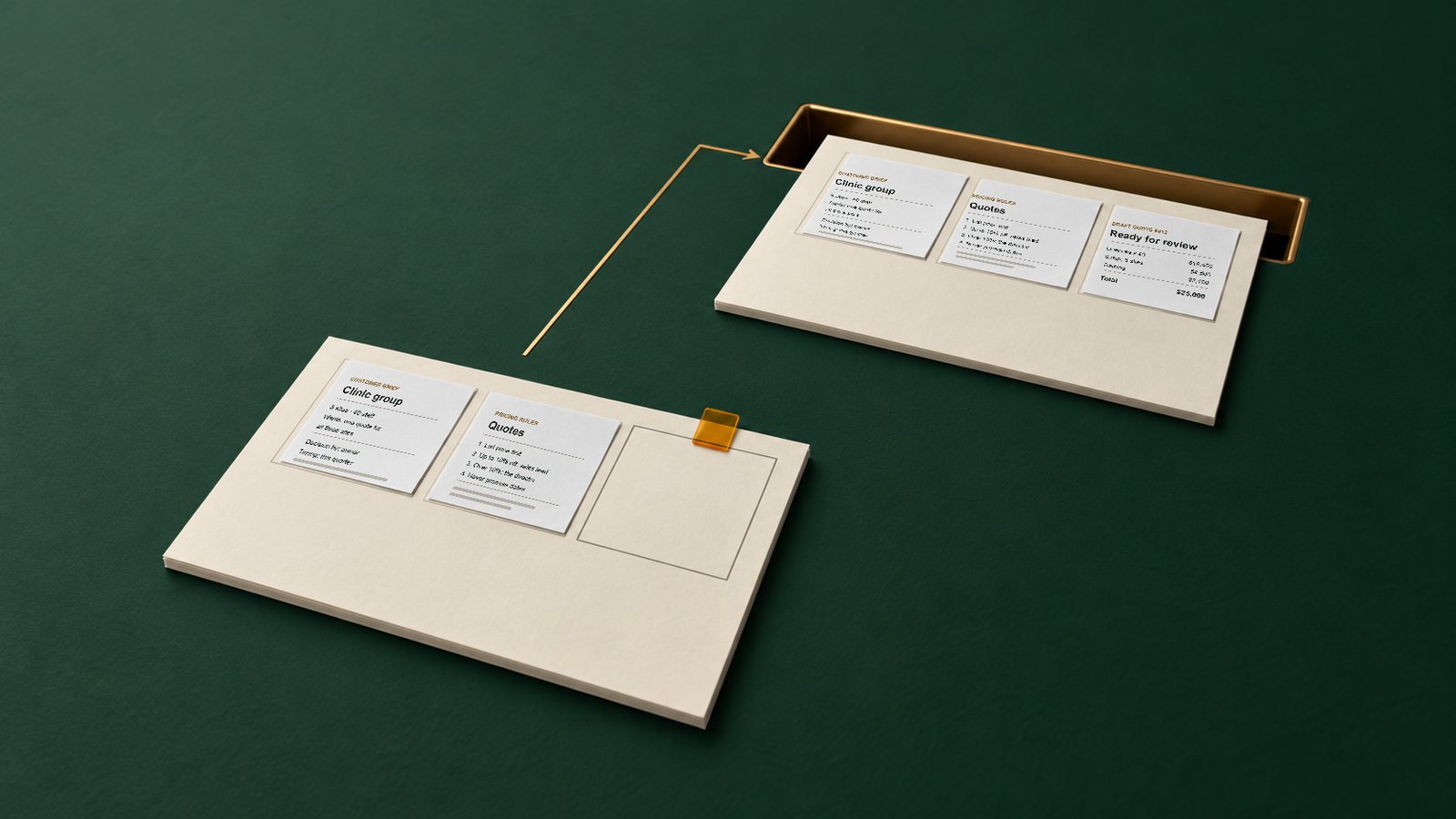
Example: a quote that waits.
A qualified buyer waits while sales checks pricing, looks for the account history and chases approval.

- 1See the whole handoff
- 2Find who it waits on
- 3Write down what they check
See the whole handoff.
Trace the request, the missing information and the approval queue. Measure how long it takes.
Find who it waits on.
Usually one person who knows the pricing rules and the account history.
Write down what they check.
Their rules become the instructions an AI agent follows. The next chapter shows the fix.
A hypothetical example, not a client result.